Saaif Khan.
I discover solutions.
Roles
Projects
Off the Clock
When something grabs me, I go all in — pickleball, sim racing, travel, and showing up for the people around me, no half measures.
Five agencies inside New York State
The story
My mentor — a Technical Sales Leader (IBM's version of an Account Executive) covering Core 2, a mid-revenue slice of ~40+ agencies inside a New York State enterprise account spanning 150+ agencies total — handed me the reins to engage five of them directly. For each, I drafted an engagement game plan: researched the key stakeholders, figured out what the agency was actually working on, and ran outreach through tools like ZoomInfo and LinkedIn Sales Navigator. I worked across opportunities sitting in different stages of the deal cycle and tracked all of it through our CRM. Between the two of us, we moved six active opportunities forward.
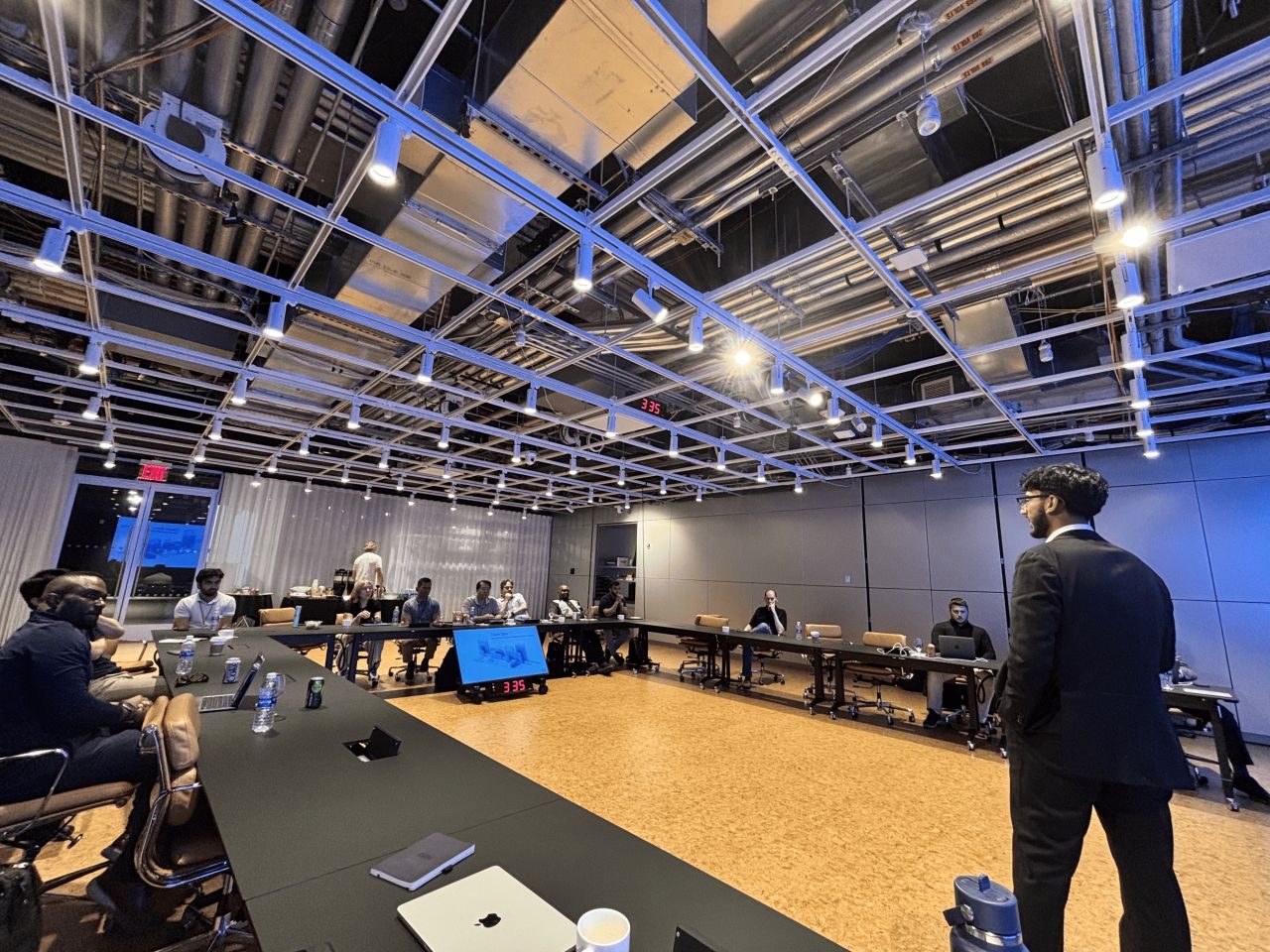
Three of those came out of rooms I stood up myself. What I'm proudest of here is the client-facing work — presenting in person, whether clients came to our New York City office, we visited a client site, or we hosted them at our Yorktown facility. I built the financial models and ROI mock-ups behind those pitches, ran the business value assessments, and presented IBM client-zero stories translated into language a public-sector buyer will actually act on. Two produced follow-up meetings.
In pictures
What I built here
The receipts
By the numbers
The platform nobody opened
The story
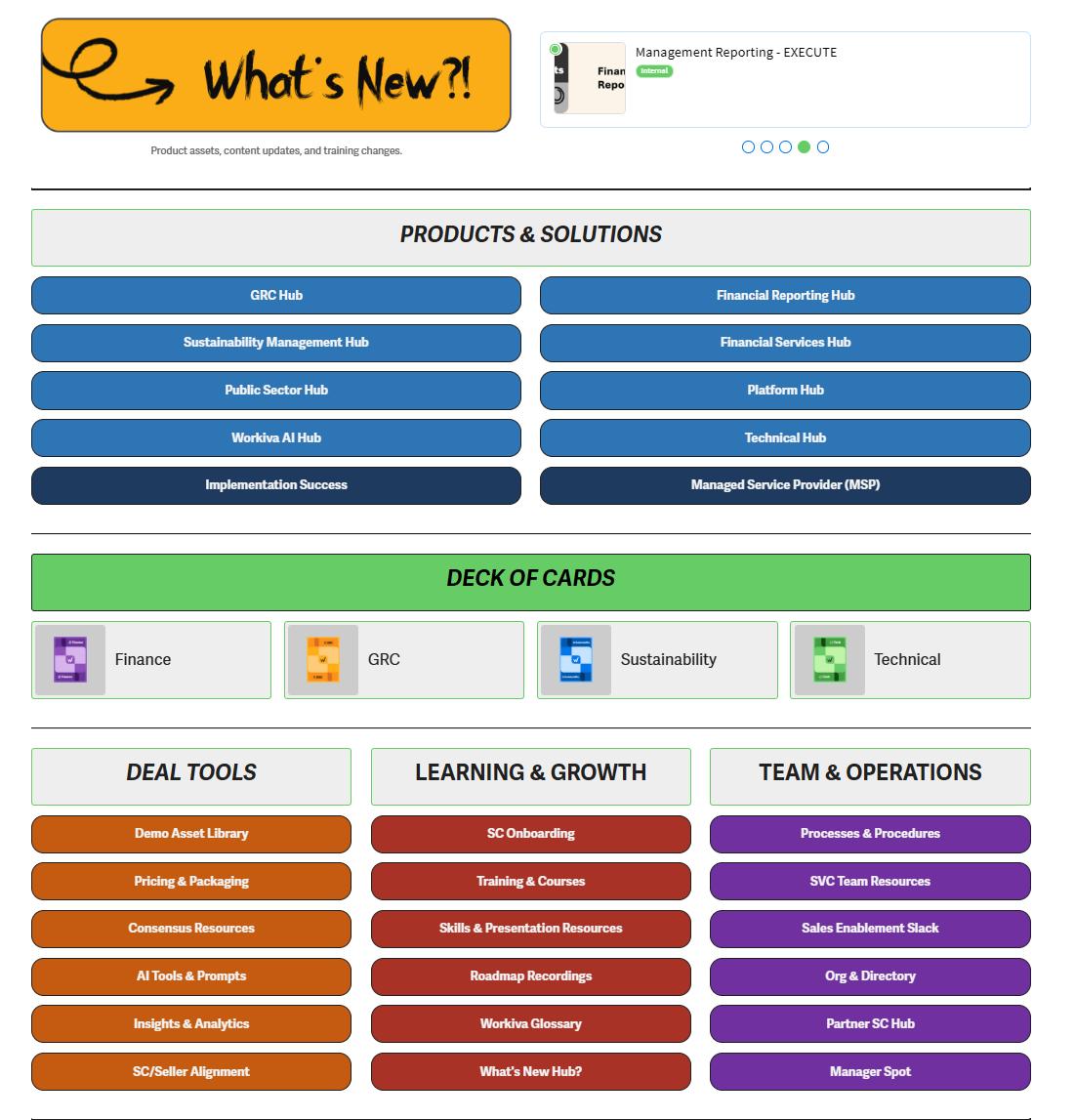
Workiva's Highspot enablement platform served 230+ Sales Engineers globally, and adoption was failing. My job was to find out why with evidence, not opinion. I designed a 50-question behavioural survey, analysed the failure quantitatively, and produced the baseline metrics that defined the redesign's scope and business case.
The data gave me five distinct personas, and every architecture decision after that traced back to one of them. I built an 18-page information architecture from scratch with a tagging taxonomy standard and a governance framework covering content ownership, expiration enforcement, and migration rules for 259 audited assets. Then I demoed V2 to 90+ Sales Engineers, anchoring each decision to a specific pain point from discovery — the only way a room full of SEs will believe you.
In pictures
What I built here
By the numbers
What they said
“His maturity in masterful communication is remarkable, particularly because it is balanced by his technical acumen.”
Kim Fisher · Senior Enablement Leader, Workiva · direct managerSixty discovery calls in Boulder
The story
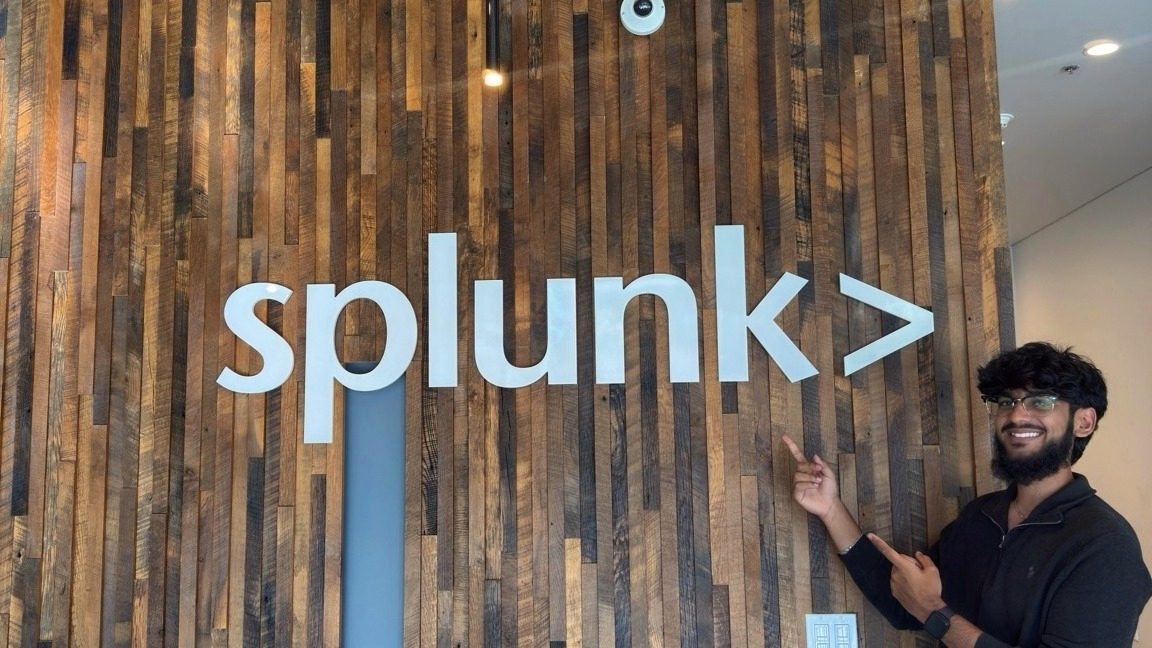
Boulder is where I learned what the job actually is. I shadowed 60+ discovery calls, demos, and workshops alongside AEs and Sales Engineers, ran live chat support during customer workshops answering questions in real time, and helped a full-time Solutions Engineer put together an RFP response for a client opportunity worth $1M+ in pipeline.
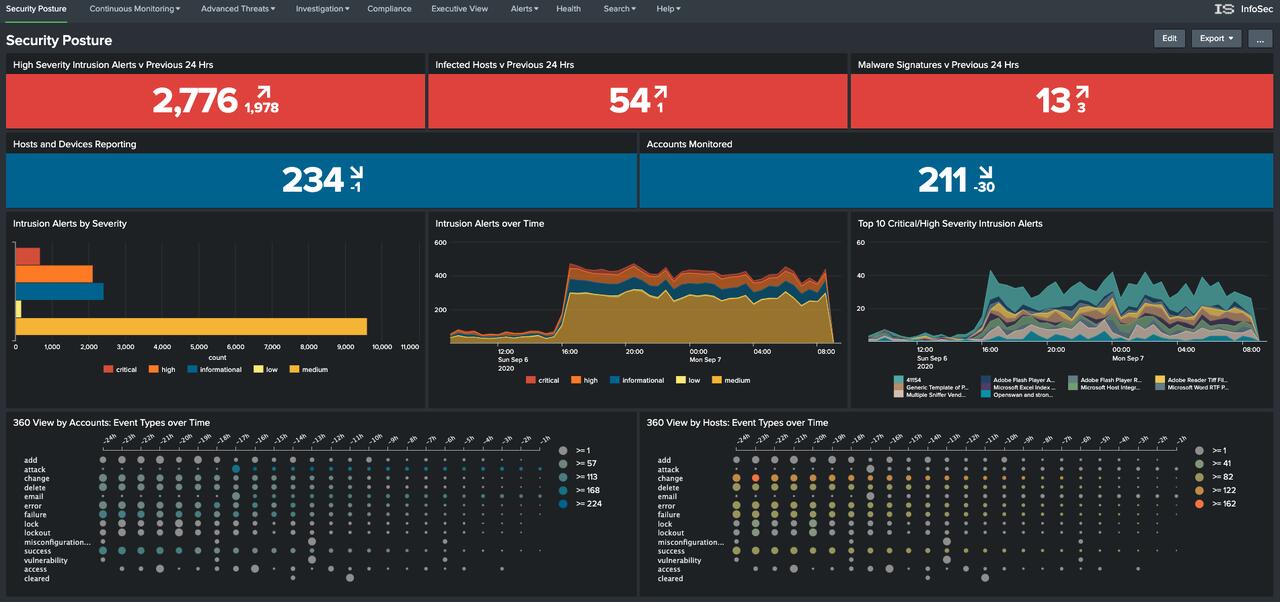
I co-led four customer enablement workshops, three-hour hands-on sessions with clients and prospects, and built a predictive flight delay dashboard on Splunk MLTK that reached 89% accuracy — a real solution to a problem a lot of people deal with. Demoing it live to 30+ senior leaders was where value selling and storytelling mattered as much as the model: showing the technical build and the business case in the same breath.
In pictures
What I built here
By the numbers
What they said
“He has a unique ability to connect the value of our solutions to clients through compelling storytelling and engaging demos.”
Nick Higgins · Technical Sales Leader, CiscoCopilot, and the people who won't use it
The story
A contract engagement inside U.S. Renal Care's supply chain management team, brought in as what I called myself going in: an AI Solutions Consultant. The team had just picked up Microsoft Copilot enterprise licenses and had real use cases waiting — Smartsheet workflows that were still entirely manual — but an older, less AI-native workforce that didn't know where to start.
My team and I ran discovery interviews to find out what people were actually confused by and what they needed, then built documentation covering Copilot adoption from complete beginner to advanced. We tied the final product directly back to the pain points from those interviews before presenting it — the same motion as pre-sales run against internal stakeholders instead of a buying committee.
By the numbers
A hundred grand, run solo
The story
I grew up around people who loved business — friends in the jewelry trade, friends flipping used electronics — and it rubbed off. I sourced a product line from a manufacturer to resell on eBay, tested a few categories, ran the numbers, and landed on headphones and microphones. From sample orders and market research, I built the business from the ground up to roughly $100k in annual revenue, run alone alongside a full course load.
Two years, 2,500+ transactions, a sustained 98% satisfaction rate. Revenue grew 568% year over year because I got good at finding demand before it was obvious: identifying niches, pricing against the market, and reading conversion data like a sales funnel, because that's what it was. I expanded the catalogue 800% and lifted monthly sales 45% through targeted campaigns, placement optimisation, and upselling, ending with 300+ repeat customers. Nobody set me a quota and nobody covered a bad month — the closest thing to owning a P&L I could get at nineteen. Eventually I realized the more interesting question was how sales actually works, which is what pushed me toward technical sales in the first place.
By the numbers
The sales engineering track
Why this degree
Management Information Systems — UT Dallas calls it Computer Information Systems and Technology — on the IT Sales Engineering track is a degree built for exactly one job: technical enough to earn credibility in the room, commercial enough to know what to do once you have it. Half the curriculum is cloud, code, and security; the other half is discovery, solution selling, and business finance. I'm graduating a semester early, in December 2026, and I'm planning to pursue an MBA down the line as my career develops.
Coursework
Cloud Computing (AWS) · Object-Oriented Programming (Python) · Foundations of Business Intelligence · Systems Analysis & Design · Database Fundamentals · Network & Information Security · Quantitative Business Analysis · Advanced Solution Selling · Digital Prospecting · Business Finance
Orgs & involvement
█████████
Unlocks in
KDR Generator
The problem
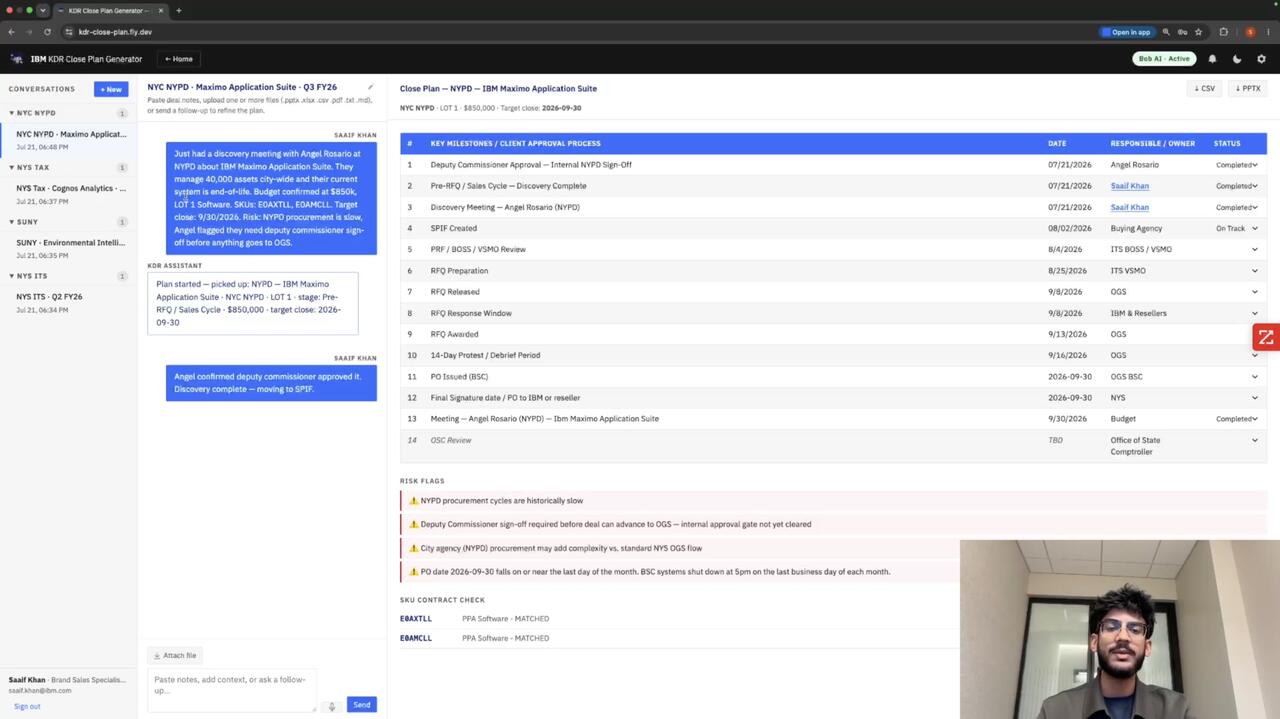
Built for the IBM watsonx Challenge, on a team with a full-time technical seller and a managing director for the State of New York — I led the initiative and built it myself. Sellers were spending up to three hours assembling a single Key Deal Review (KDR) deck and timeline for their seniority manager before every cadence meeting, almost all of it manual. I built a full-stack AI application on IBM Bob (Claude Sonnet 4.6) that turns raw seller notes into a complete 12-stage NYS OGS close plan in under thirty seconds — a 60× reduction.
How it works
Four distinct AI workflows underneath: structured deal extraction, skeleton inference, conversational plan patching, and deal narrative generation. Each emits strict JSON with a regex-based fallback so production never goes down. It validates against a 5,000+ SKU IBM OGS pricelist in real time, authenticates against @ibm.com, and routes email and in-app notifications through a milestone tagging system to whoever owns the next step.
See it
Built during
By the numbers
SE Highspot V2
The problem
Workiva had recently adopted a V1 of the Highspot enablement platform, and it wasn't landing — a platform for 230+ Solution Consultants that people worked around instead of through. I was brought in alongside another intern to rebuild it into a V2. Rather than guess at fixes, I diagnosed the adoption failure first: a 50-question behavioural survey, quantitative analysis, and a 5-persona segmentation model built from the raw responses.
What I designed
An 18-page information architecture from scratch — tagging taxonomy, governance policy framework, content migration rules, and a zero-training-required navigation system replacing a disorganised V1. Recommendations targeted a 40% reduction in Slack reliance and a projected 30%+ improvement in asset time-to-find, validated through survey correlation analysis.
See it
Built during
By the numbers
FlightFlow
What it does
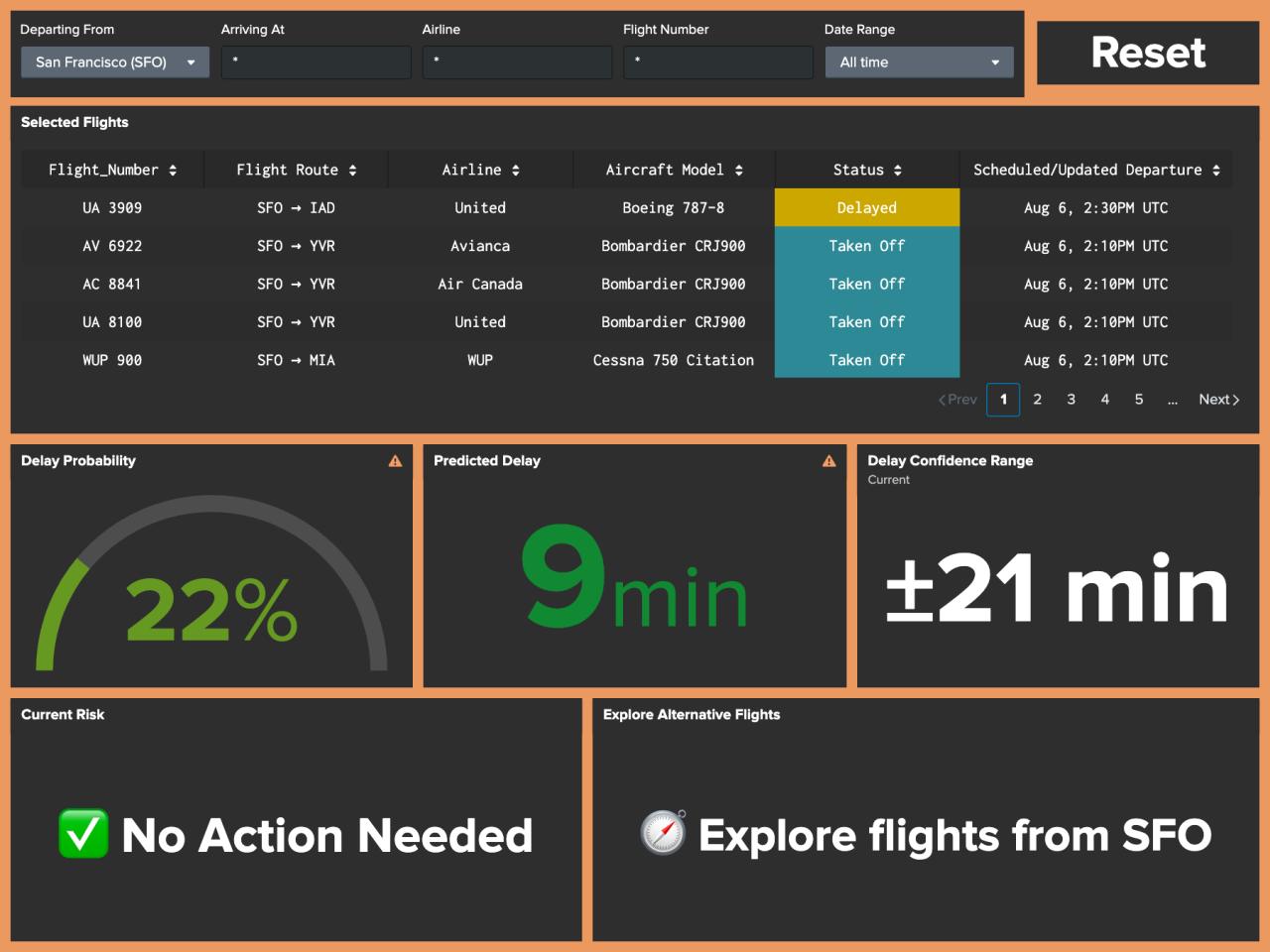
Real-time and historical flight delay intelligence across 10 major U.S. airports, integrating four live data sources — BTS, AeroDataBox, OpenWeather, and AVWX. Splunk MLTK models predict both delay probability and duration; forecast accuracy improved 23% in testing and the final model reached 89%.
The part I'd demo first
The alerts engine. It flags at-risk flights from weather, historical delay patterns, and operational metrics, then recommends alternate actions — up to 40% less disruption impact in simulation. I presented it live to 32+ Splunk senior leaders.
See it
The demo
▶ Watch the demoFlightFlow walkthrough ↗Built during
By the numbers
Food Access Risk
What it does
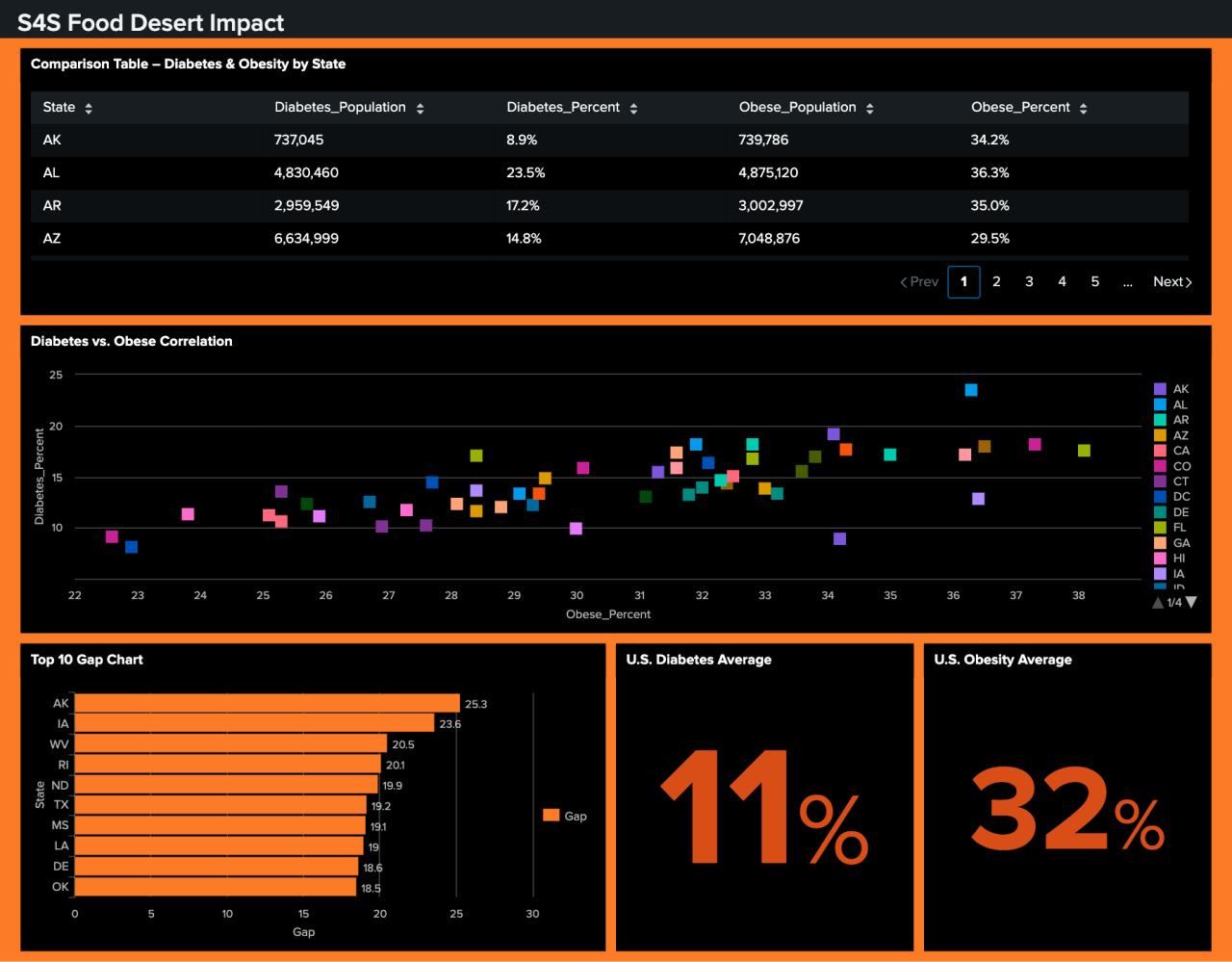
County-level food access risk built from USDA datasets, with state filtering, choropleth mapping, and dynamic summaries that surface the top 10 highest-risk counties per region. It correlates access against diabetes and obesity rates to show where the gaps compound.
Normalising and visualising the data cut prep time 35% for every social-impact analysis downstream of it.
See it
Built during
By the numbers
Valor
The brief
A 5-member team, a Bank of America brief, and IBM watsonx. We built Valor, an AI-driven chatbot leveraging IBM watsonx to enhance veteran engagement and financial literacy for Bank of America. I helped conduct competitive analysis, define customer-centric solutions, and deliver a client-ready pitch showcasing projected improvements in customer satisfaction and cost efficiency — a panel of four judges, projecting a 20% lift in veteran engagement.
The focus throughout was aligning AI capabilities with actual business objectives to drive client and end-user value — my first real attempt at mapping a technology's capabilities onto a client's business goals, which turned out to be the entire job description.
See it

By the numbers
The site you're standing in
The problem
A portfolio for a technical seller has to prove two things at once: that I can build the thing, and that I can sell it. A scrolling page proves neither — it just asserts them in bullet points. So the site is the argument. Every tile lives at real coordinates on one 8600 × 7000 spatial map at three depths, and the only way to read anything is to fly a camera to it. Navigating it is the demo.
The constraint that shaped everything
Chrome's hit-testing is unreliable for content under nested 3D transforms. Clicks, hover, and the cursor all resolve against the wrong coordinate space — silently, with no console error, and the failure changes with window size. Three drafts died to it, and every fix that trusted e.target failed for the same reason.
So the world stopped trusting the browser. Every interactive element's screen box is measured after each flight, and clicks, hover states, and the pointer cursor all resolve geometrically against those boxes. Smallest box wins, so a row beats the tile containing it. The focused tile is treated as opaque, so nothing behind it can steal a click.
What it cost to make fast
What I turned down
A custom cursor — it vanishes whenever the pointer enters the page without a mousemove, which is a total failure on a page someone opens once. Sound. Scroll-jacking. A framework. Each one would have made this look like all the others, which was the only outcome that mattered to avoid.
Built for
By the numbers
The stack
Pickleball
The story
It started with a cheap net set in a friend's driveway one summer in high school. I'd played football growing up, and once life got busier, pickleball became the way I stayed in a physical sport without needing ten other people to coordinate a Sunday. I started playing seriously in May 2025 — singles and doubles against strangers at Ace Pickleball Club, plus tournaments there and through MSA. Favorite memory so far: running into an intern I'd met last summer at Splunk and playing with a group of full-timers after work.
Formula 1 Racing
The story
Once I got into watching Formula 1, I didn't stop at watching. I picked up a racing simulator rig and now compete in virtual leagues on F1 26, and I've taken it off-screen with real go-karting too. It's the same pattern as pickleball — once something clicks with me, I go all in.
Travel
The story
I've been chasing new places for years. Internationally, the trips I'd talk about first — Tokyo, Kyoto, and Osaka in Japan, Bali in Indonesia, Istanbul in Turkey, Dubai in the UAE, and Toronto in Canada — most of them with a couple of close friends. Domestically: California, Alabama, Florida, Tennessee, Texas, New York, Colorado, Illinois, North Carolina, Kansas, Missouri, Georgia, Oklahoma, New Mexico, and Virginia. Always open to where's next.
Video Games
The story
I've played video games my whole life — Call of Duty, Minecraft, Fortnite, Madden, FIFA. Grand Theft Auto V is my favorite of all time, and I'm counting down to GTA VI like everyone else. I don't have as much time to play these days, but it's never really left.
Food & Coffee
The story
I love eating out and trying new cuisines — I'd rather try somewhere I haven't been than go back to a place I already know is good. Coffee and matcha are a constant.
Community
The story
Giving back isn't a once-a-year thing for me. On Islamic Relief's service committee, I helped plan and host charity events — including ones for kids with disabilities, giving their parents a day to themselves — plus a run of fundraisers. In Alpha Kappa Psi, I served as lead event coordinator for the service committee: running our charity basketball tournament, where teams paid to compete and the proceeds went to charity, and organizing volunteer events like nursing home visits and donation drives. I'm also part of the Muslim Student Association at UT Dallas.
In their words
LinkedIn recommendations from the people I've reported to, been mentored by, and built alongside.
From the people who managed me
“Saaif interned on my team at IBM this summer and did an incredible job. He is extremely proactive — he takes initiative to solve problems and take tasks off of others' plates without being asked. He sees what needs to be done and executes with high competency. He is a strong communicator and quick learner with high emotional intelligence and interpersonal skills. We were so lucky to have him with us this summer and he has my high recommendation as a stellar team member.”
View profile ↗“Saaif has a unique ability to balance technical mindset with human connection. Over the course of his time with my team, I was impressed with his proactive engagement with his project stakeholders, consistently validating his hypothesis, plans, and desired outcomes. His maturity in masterful communication is remarkable, particularly because it is balanced by his technical acumen. Having spent the majority of my career in technical sales and solution consulting, I highly recommend Saaif for roles in these fields.”
View profile ↗“It was a pleasure to work with Saaif during his internship on our Global Solution Consulting Enablement team. What stood out the most is his skill in leveraging AI to drive efficiencies in his projects, combined with an exceptional ability to communicate well and articulate value. He is sharp, articulate, and highly efficient. Any team would be lucky to have him!”
View profile ↗From leaders & mentors
“Saaif is incredibly bright — he picked up the technical aspects of our software at a pace that exceeded expectations, mastering complex concepts in a short amount of time. What really set Saaif apart was his elevated sense of salesmanship. He has a unique ability to connect the value of our solutions to clients through compelling storytelling and engaging demos. His presentations not only showcased our technology's capabilities but also resonated deeply with customers, leaving a lasting impact. I would recommend Saaif to any organization looking for an ambitious and talented solutions engineer — but I sincerely hope we have the opportunity to work with him again first!”
View profile ↗“Saaif has an innate ability to learn new concepts and technologies incredibly quickly, and he's equally skilled at applying them in real-world scenarios. Ask him about his Splunk passion project — we were all blown away by the real-time data ingestion and machine learning concepts he applied! He works seamlessly with other Solutions Engineers and cross-functional teams, contributing ideas, supporting his peers, and always fostering a collaborative spirit. What truly stands out is Saaif's willingness to go above and beyond. He's a driven, resourceful professional with a bright future ahead.”
View profile ↗“Saaif is thoughtful and engages deeply with topics. He loves AI and has a good understanding of the sales cycle. He will make an excellent SE or Consultant based on having both technical and people skills.”
View profile ↗From the people I built alongside
“Saaif has a rare mix of technical skill, creativity, and composure under pressure. From building an API-powered flight delay dashboard to designing tools that help communities address food insecurity, he consistently turned ideas into impactful, data-driven solutions. What stood out most was his calm, customer-first approach in high-pressure situations, always focused on understanding the problem and finding the right path forward.”
View profile ↗“Throughout the summer, Saaif and I frequently exchanged ideas and shared insights, consistently pushing each other to grow and improve. One memorable example was during a demo of my MVP for a college football analytics dashboard I built with Splunk. Saaif suggested adding a head-to-head matchups page to showcase historical performance between two teams. This idea not only enhanced the user experience but became a key feature in my final product.”
View profile ↗“Even though we worked in different roles — me as a front-end engineering intern and him as a solutions engineer — Saaif was always ready to share his knowledge, offer guidance, and jump in to help solve problems. He's approachable, collaborative, and genuinely invested in the success of those around him. Anyone would be lucky to have him on their team.”
View profile ↗“Saaif and I interned at Splunk this summer — him as a Solutions Engineer and me as a SWE — and we had a great time bouncing ideas off each other. He showed me some awesome demos he built, and I shared coding ideas back with him. Saaif's curiosity, technical skills, and easygoing nature made him a great teammate, and I know he'll do great things wherever he goes next.”
View profile ↗